
“Automated recurring invoicing” can mean at least three different things: generate a draft, send a finished invoice, or charge a saved payment method. Invoice Master supports draft generation and Premium automatic email. When a schedule runs, it creates an invoice and advances the schedule. Leave automatic delivery off for a draft you review and send, or enable it with Premium and choose a recipient email to issue and email the invoice automatically.
The customer still chooses when to pay. Recurring schedules do not charge a saved card or bank account. Keep draft review for retainers or repeat services whose quantities, contacts, or tax context can change.
What a recurring configuration stores
A recurring invoice record contains:
- sender and recipient details;
- recurring line items;
- invoice footnotes;
- a recurrence interval using days, weeks, months, or years plus an integer step;
- the next issue date and an optional end date;
- the automatic delivery choice and recipient email; and
- payment terms, either due on receipt or a net number of days.
When the date arrives, Invoice Master uses that configuration to create a draft invoice and calculates its due date from the stored payment terms. It then advances the next issue date. With automatic delivery enabled, Premium issues and emails the invoice; otherwise it stays a draft and the system attempts to notify the owner. Check the invoice list and automatic delivery status to confirm what was generated and sent.
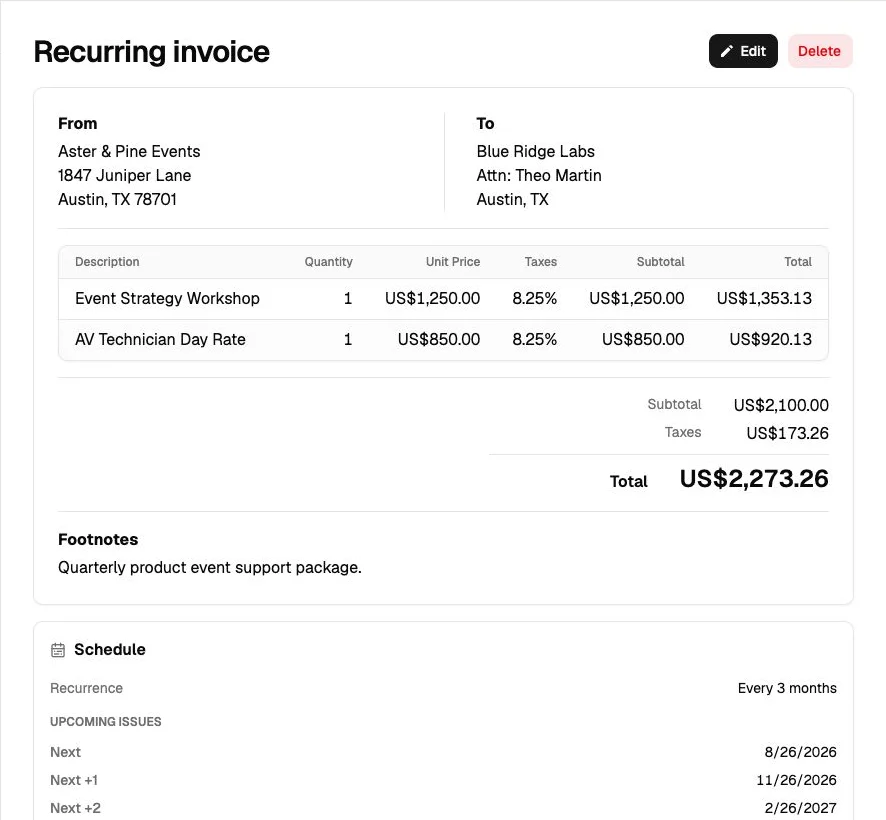
August 2026 staging capture using fictional parties, services, dates, and amounts. It shows the saved recurring configuration, not automatic delivery or charging.
You create and edit the recurring configuration separately. A generated invoice is saved in the application, unlike browser-local draft recovery. There is no current “turn this invoice into a recurring template” command, pause switch, or automatic attachment carryover. Set an end date, or delete or edit the configuration when the commercial arrangement changes.
Choose recurring work that is genuinely repeatable
Good candidates have a stable customer, cadence, description, and price: a monthly retainer, maintenance fee, membership invoice, or regular service allowance. Usage-based work, changing expenses, milestone billing, and variable taxes need more review.
Write the line item so it remains meaningful when copied into a future draft. Include the period or service name, but avoid hard-coding a calendar month that will become stale. With automatic delivery off, the generated draft can be edited before sending.
Choose draft review or automatic delivery
For invoices that need individual checks, leave automatic delivery off and use a short review sequence:
- Confirm the customer is still active and the billing entity has not changed.
- Check the service period, quantity, rate, tax, and currency.
- Confirm the issue and due dates.
- Update purchase-order or project references.
- Add any one-off adjustment supported by the invoice form.
- Preview the customer-facing PDF or public view.
- Check any automatically created Stripe link, or create one with Premium if appropriate.
- Deliver the invoice through the chosen route.
For stable invoices, Premium automatic delivery can handle the sending step. Check the saved details and recipient email before enabling it, and monitor delivery status afterward. Scheduling does not replace acceptance or tax review.
How Free plan limits affect generation
The backend applies the normal monthly invoice-creation entitlement to scheduled drafts. Free allows five invoices per month. If a Free organization has reached that limit when a recurring schedule runs, the invoice is skipped, the next issue date advances, and the Backend attempts to queue a monthly-limit notice. A queue failure does not change that skipped result.
This is why “five recurring invoices per month” is an inaccurate description. The limit is on invoices created during the month, whether created manually or by a recurring schedule. Premium bypasses that invoice-count limit.
Review skipped-generation notices promptly. Because the next date advances, waiting until the following cycle can leave a genuine billing period unissued.
Pair recurring invoices with Premium collection tools
Premium can email generated invoices automatically, or you can send them after draft review. It can also create a Stripe-hosted payment link automatically when Stripe is connected and automatic payment links are enabled in organization settings. If link creation fails, invoice generation continues without it, so check the payment route. Premium dunning can schedule owner or customer email stages after the due date; the late-payment reminder sequence shows where automation should yield to a person. Those are separate actions:
- recurring scheduling creates the invoice;
- document delivery emails it automatically when configured, or you send or share it yourself;
- a Stripe link offers hosted checkout; and
- dunning follows an eligible unpaid invoice after its due date.
A payment link lets the customer complete checkout; it does not authorize scheduled card-on-file charging. Recurring templates also do not carry attachments into generated invoices.
Monthly controls
- Compare expected recurring invoices with invoices actually created.
- Investigate skipped-generation notifications.
- Review old configurations whose customer or price changed.
- Confirm delivery, including failed or skipped automatic sends, rather than assuming generation means the customer received an invoice.
- Check that payment links belong to the current invoice.
- Reconcile paid status to payment history.
Recurring schedules reduce repetitive typing and can automate delivery with Premium. Keep individual draft review where the work changes, and review saved settings regularly so a repeated mistake does not become a monthly one.