
Small businesses that invoice through Stripe
Use it when you want customers to pay an invoice online while Stripe continues to handle checkout, fees, and payouts.

Get paid
Share an invoice payment link so customers can pay through Stripe. For unpaid invoices marked Issued, Invoice Master checks and records the full payment.
A payment from start to finish
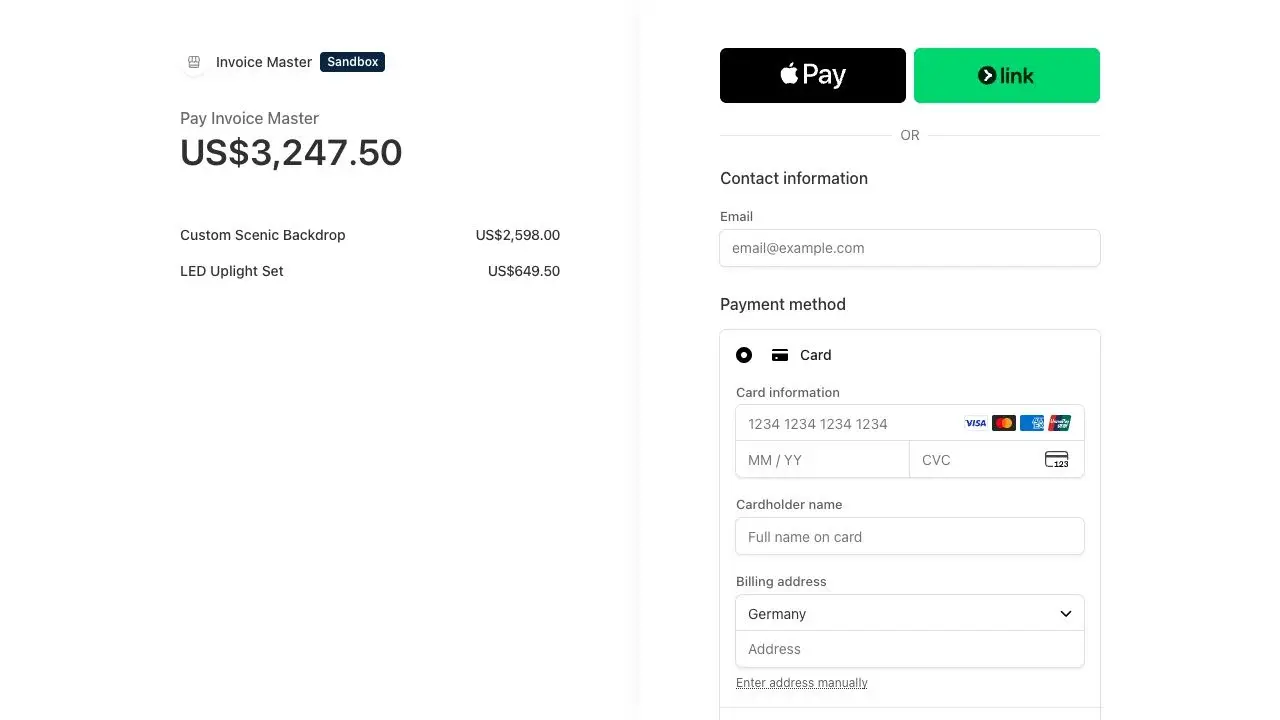
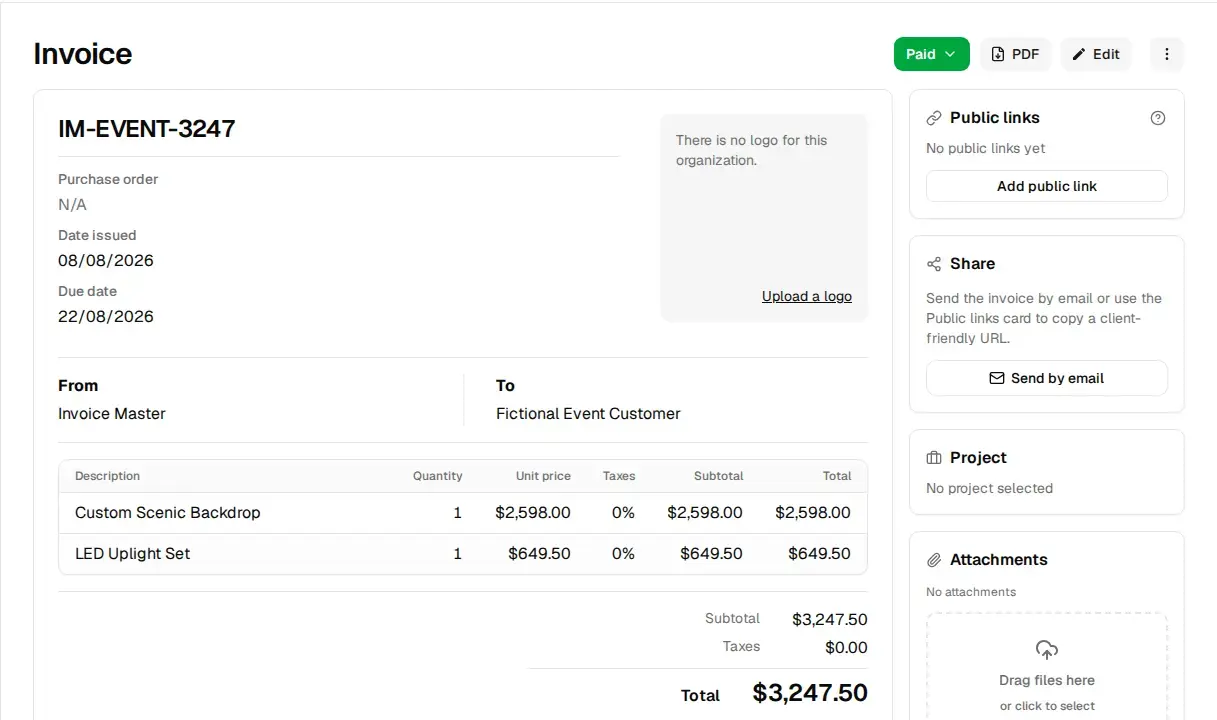
These test screenshots use a fictional US$3,247.50 invoice for event equipment. The example checkout uses Stripe sandbox, so no live charge was made.
Customer view
Customers open checkout from a shared public invoice or a direct Stripe link. They can review the invoice items and total, then pay without an Invoice Master account. Stripe decides which payment methods appear.
Invoice Master view
This is the same invoice after Invoice Master checks and records the full payment. Its balance is now zero and its status is Paid. Each link allows one completed checkout.
What happens
Connect an unpaid invoice marked Issued to Stripe Checkout. Invoice Master checks the confirmed payment before adding it to the invoice history.
Payment links require Premium. Compare the Free and Premium plans.
Start with an unpaid invoice marked Issued. It needs a currency, line items, and a total above zero. Create a Stripe payment link for that full amount. Do not use the link after recording a partial payment.
Customers can pay from a shared public invoice or direct Stripe link without an Invoice Master account. Checkout happens on a page hosted by Stripe.
After Stripe confirms a payment, Invoice Master checks that it matches the current link. For an unpaid invoice marked Issued, it records a valid full payment. The balance becomes zero and the status changes to Paid.
Stripe handles payment approval and decides which payment methods are available. It also manages processing fees, disputes, and payouts for your connected account.
Issue refunds or handle disputes in Stripe. Then add the matching Refund or Chargeback entry to the invoice history in Invoice Master.
Card details go directly to Stripe. Invoice Master does not receive or store the customer’s raw card details.
Payment responsibilities
See where to manage each part of an invoice payment.
| Capability | Invoice Master support |
|---|---|
| Create and share the invoice payment link | Invoice Master, on Premium with a connected Stripe account |
| Host checkout and determine available payment methods | Stripe |
| Record a valid full payment and update the balance | Invoice Master checks the current link, amount, currency, account, and invoice before recording the payment. |
| Set processing fees and payout timing | Stripe |
| Issue refunds and handle disputes | Stripe handles the refund or dispute. You add the matching Refund or Chargeback entry in Invoice Master. |
| Collect raw card details | Stripe; Invoice Master does not receive them |
Good fit
Use it when you want customers to pay an invoice online while Stripe continues to handle checkout, fees, and payouts.
Share one link that takes the customer to Stripe checkout. They do not need an Invoice Master account.
Keep each online payment in the invoice history. For an unpaid invoice marked Issued, a valid full payment clears the balance and changes the status to Paid.
Setup checklist
Connect Stripe once. Use payment links for the full amount of an unpaid invoice marked Issued.
Connect the organization’s own Stripe account and finish any required Stripe business and payout setup.
Use an unpaid invoice marked Issued. Check its currency, line items, and payment terms. The total must be above zero. Do not create this link if a partial payment is already recorded.
Generate the Stripe-hosted link, then send the invoice or share the payment link through your usual customer channel.
The payer opens the Stripe-hosted checkout page. Stripe decides which payment methods appear for that checkout.
Check the payment history after checkout. For an unpaid invoice marked Issued, a valid full payment adds a record and clears the balance. The status changes to Paid.
Keep exploring
Read the guide for setup steps and help keeping payment records in sync with Stripe.
Read the Stripe invoice payment workflow guideCreate read-only public invoice links that clients can open without a login, use for PDF download, and lose access to when a link expires or is deleted.
Schedule invoice reminder emails and choose who receives them. Pause or adjust follow-up for individual invoices.
Create invoices and quotes in the currency agreed with your client. Keep exchange-rate notes with each record and send Stripe payment links in the invoice currency.
Details
Customers use a payment link to pay an invoice online. In Invoice Master, the link opens Stripe checkout for the full invoice amount. Invoice Master checks each confirmed payment before adding it to the invoice history.
Yes. Your organization needs Premium and a connected Stripe account. Create a link for the full amount of an unpaid invoice marked Issued. Do not use it if a partial payment is already recorded.
No. Customers can pay from a shared public invoice or direct Stripe link without creating an Invoice Master account.
You need Premium and a connected Stripe account. Use an unpaid invoice marked Issued, with a currency, line items, and a total above zero. Finish any required Stripe account setup before sharing the link.
Stripe determines which payment methods appear for each checkout. Invoice Master does not promise a fixed list of methods.
Yes, for an unpaid invoice marked Issued. Invoice Master checks the full payment, adds a payment record, and clears the balance. The status changes to Paid. Other invoice statuses may stay the same. If a payment exceeds the remaining balance, Invoice Master flags it for review instead of recording it. You must record later refunds or chargebacks manually.
No. The link charges the full invoice total, including tax. It does not adjust to the remaining balance. Do not use it after recording a partial payment. Add partial payments separately in the invoice payment history.
Invoice Master does not add a payment record or change the invoice status unless Stripe confirms a valid successful payment.
Stripe pricing applies to your connected account. Invoice Master does not calculate or subtract Stripe fees from the invoice payment record.
Stripe manages the payout schedule for your connected account. Check the current timing in your Stripe dashboard.
Issue the refund or handle the dispute in Stripe. Then add the matching Refund or Chargeback entry to the invoice history in Invoice Master.
No. Raw card details go directly to Stripe. Invoice Master does not receive or store them.
Ready when you are
Connect Stripe on Premium and prepare an unpaid invoice marked Issued. You can then share a link for the full invoice amount.