
Invoice Master tracks business outgoings through bills. A bill records what a supplier charged; it is not a receipt scanner, employee expense claim, bank transaction, or accounts-payable payment ledger.
That distinction determines which questions the feature can answer reliably.
Product check, July 12, 2026: Bills currently have no receipt attachment, OCR, recurring schedule, approval flow, payment status, or automatic bank match.
What a bill records
A bill can hold the supplier or sender, an internal number and supplier invoice number, issue date, due date, currency, footnotes, and line items with amounts and tax. It can also link to a supplier company and a project.
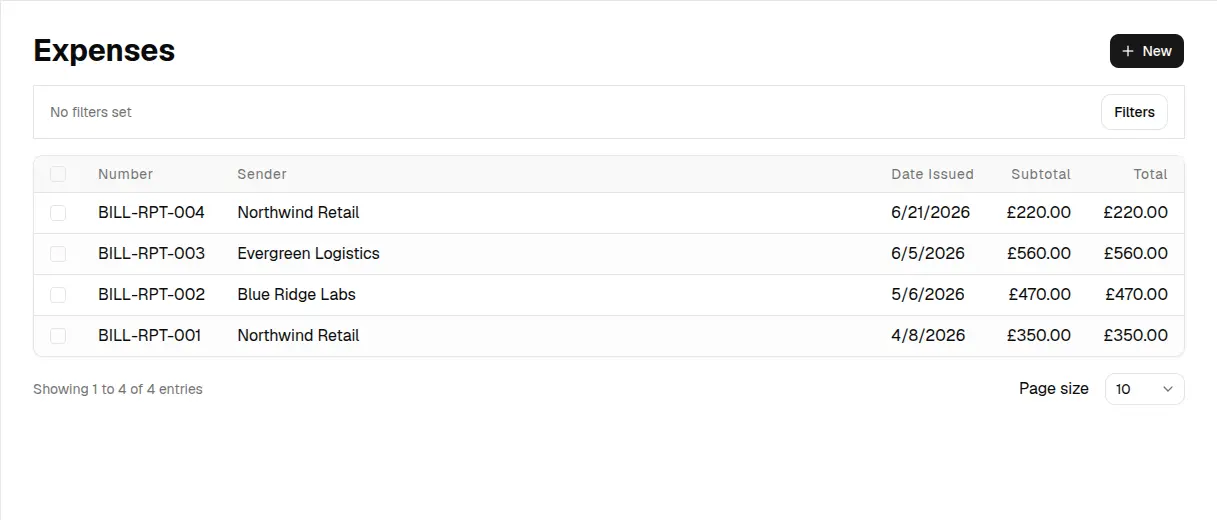
Seeded demo bill records. Suppliers and values are illustrative.
Use the supplier’s invoice number exactly as shown on the source document. Use descriptions that explain the cost rather than a generic “expense.” If several projects share a supplier bill, decide on an allocation outside the tool; a bill has an optional project relationship, not a line-by-line cost-allocation engine.
The source document still needs a home
Because the bill record has no file attachment, keep the supplier PDF, receipt, or other evidence in an appropriate document system. Use a naming convention that connects it to the Invoice Master bill, such as:
2026-07-03_SUPPLIER_INV-4821_EUR-640.pdf
Restrict access where documents contain personal or payment data. Back up files according to your retention obligations. The Invoice Master organization archive should not be treated as proof that every external receipt binary is included.
Record tax and currency deliberately
Enter the currency from the supplier document. Invoice Master does not calculate exchange rates or create home-currency postings. If your books require an exchange rate, base currency, recoverable tax account, or special import treatment, preserve that in the accounting system and document the rate source.
Line-item tax in a bill is only as correct as the information entered. The application does not determine whether VAT or GST is recoverable or whether a receipt meets a jurisdiction’s evidence rules.
Project costs and the financial view
Linking a bill to a project lets the project-based invoicing view include the cost alongside related invoices and quotes. The project widget treats bills as expenses; paid invoices contribute realized income, while issued and partially paid invoices can appear as outstanding.
This is an operational profitability view, not full job-cost accounting. It has no project budget field, committed-cost purchase orders, payroll allocation, overhead absorption, or bill payment status. A “net profit” trend reflects the records present in Invoice Master, not every economic cost in your business.
Dashboard and Premium reports
Bills feed business-level expense and profit views. Premium Reports includes a cash-in-versus-expenses report with CSV and PDF export. The dashboard and reports field guide explains the date and status boundaries. Be careful with the word “cash”: because bills have no paid/unpaid state, a recorded bill is an expense record, not proof that cash left the bank on that date.
Reconcile the report to supplier documents and bank records before using it for bookkeeping or tax work.
A practical bill-entry routine
- Save the supplier’s original document in your records system.
- Check supplier identity, invoice number, currency, issue date, and due date.
- Enter line items and tax from the source.
- Link the supplier company and project when relevant.
- Review totals against the original.
- Route and approve payment outside Invoice Master under your normal controls.
- Reconcile the bank payment and accounting entry separately.
Basic allows five bills per month. Premium removes that bill-count entitlement. Plan limits should influence whether the feature fits your volume, but they do not change the evidence you must retain.
When the feature is a good fit
Invoice Master bills work well when a small team wants supplier costs visible beside invoicing and project records, and already has a place for receipt files and bookkeeping. They are not enough for a business that needs receipt capture, corporate cards, employee reimbursement, multi-step approvals, three-way matching, or automated bank reconciliation.
Accurate expense tracking begins by naming the record correctly. A bill says a supplier charged you. Your document archive proves the charge, your bank proves payment, and your accounting ledger supplies the formal treatment.