
A dashboard is useful only when you can explain the records behind each number. “Income,” “outstanding,” and “profit” can mean different things in different products. Invoice Master’s dashboard is an operational overview; Premium Reports provides more focused accounts-receivable and cash views with exports.
Product check, July 12, 2026: This article follows the current dashboard widgets and reporting endpoints. It does not treat a chart label as a substitute for accounting policy.
Dashboard notifications: what needs attention
The notification widget surfaces overdue invoices and drafts whose issue date has passed. These are two different problems:
- an overdue invoice has been issued and passed its due date without an eligible settled status; and
- a past-issued draft may represent work that was never formally issued.
Review drafts first for validity. A draft left behind after a cancelled job should not be sent merely because the date is old. An overdue invoice may need the appropriate reminder stage, a dispute pause, a credit or cancellation decision, or a payment record.
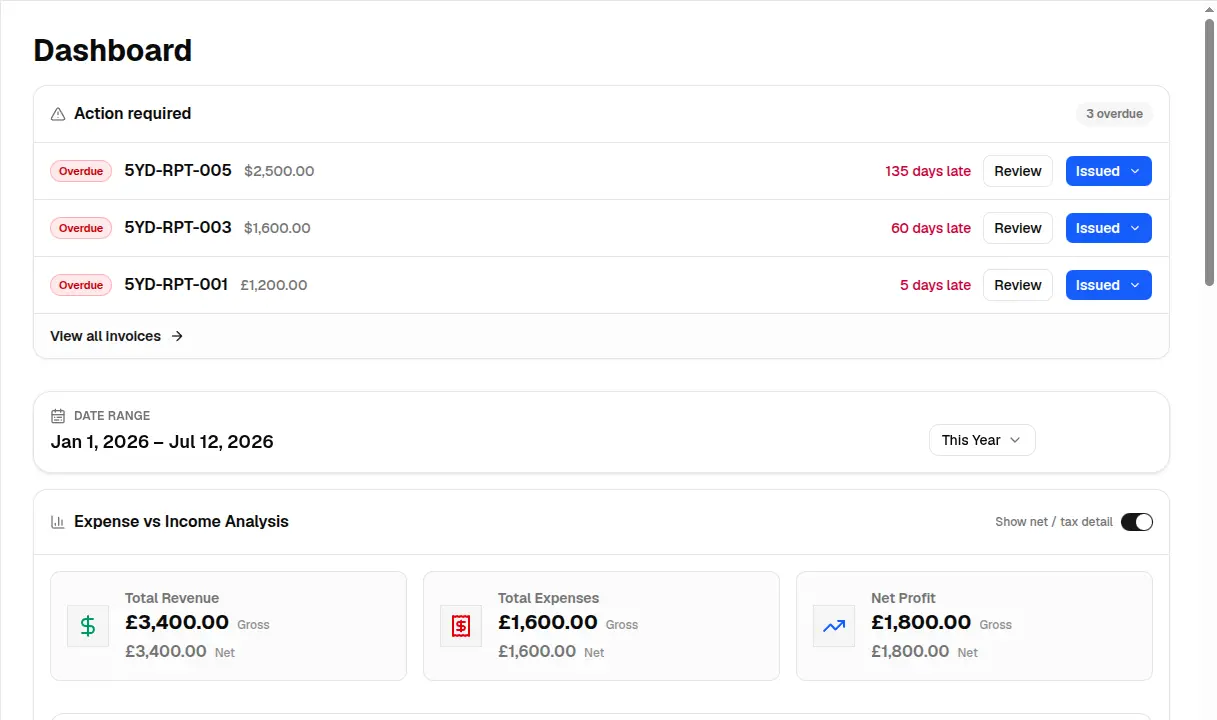
Seeded demo dashboard, captured July 12, 2026. Values illustrate widget behavior, not customer performance.
Financial performance: collected, outstanding, and expenses
The dashboard’s financial-performance view brings together collected cash, outstanding invoice amounts, bills or expenses, net and tax details, and a net-profit trend for the selected timeframe.
Interpret those categories carefully:
- Collected cash is supported by invoice payment records.
- Outstanding comes from issued or partially paid invoice balances.
- Expenses come from bill records.
- Net profit is derived from the income and bill data present in Invoice Master.
Bills do not have a payment status, so an expense in the chart is not proof of a bank payment. Payroll, overhead, processor fees, and costs stored elsewhere may be missing. This is why the result should follow a payment and bookkeeping reconciliation before being called business profit.
Invoice and income widgets
The income chart and invoice metrics help answer how much was invoiced or collected and how document statuses changed within the shared timeframe. Use the source invoice list to investigate a spike. One unusually large invoice, a refund, or a status correction can be more important than a smooth trend line.
Do not mix “issued” and “paid” when discussing performance. Issuing creates a receivable; payment creates cash history.
Quote widgets
Quote charts and metrics show the proposal side of the workflow. Quote statuses include draft, sent, accepted, rejected, and expired. An accepted quote is commercial evidence, not revenue or cash. Conversion opens a new invoice draft; it does not turn the quote amount into collected income.
Use quote metrics to inspect throughput and follow-up, then trace accepted work to the actual invoice and payment records.
What Premium Reports adds
The Premium Reports area is separate from the main dashboard and currently includes:
- accounts-receivable aging;
- overdue-balance trend;
- cash-in versus expenses, including refunds in the cash basis;
- top clients; and
- open-balance statements as PDF.
Each main report supports CSV and PDF export. The dashboard itself does not have a general “export every widget to CSV” action.
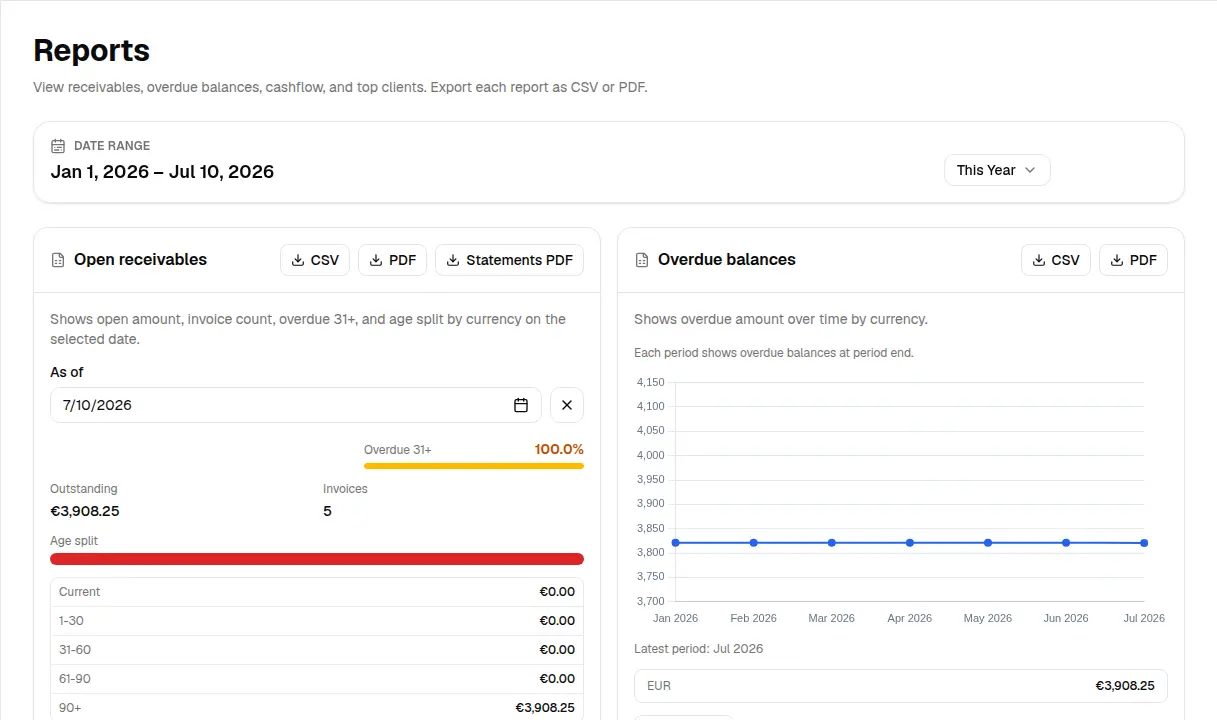
Current Premium report interface in seeded demo data. CSV, PDF, and statement controls are visible on the relevant reports.
Accounts-receivable aging belongs here, not on the dashboard. Aging buckets describe how long eligible open balances have remained outstanding. Check the as-of date and underlying invoices before using a bucket total in collection decisions.
Timeframe and currency cautions
Dashboard widgets share timeframe controls, which makes cross-widget comparison more consistent. Still ask which date drives each series: issue date, due date, payment date, or bill date.
Invoice Master supports per-document currency but does not provide an exchange-rate engine. If an organization has documents in several currencies, do not assume unlike amounts have been economically converted merely because they appear in one view. Reconcile and translate values under an explicit accounting method outside the dashboard when needed.
What the dashboard does not do
The current dashboard does not provide role-specific layouts, arbitrary saved views, accounts-receivable aging buckets, or one-click actions that automatically convert quotes, send every reminder, or mark supplier bills paid. Some display preferences can persist locally, but that is not a shared reporting workspace.
A useful weekly review
- Resolve old drafts: issue, update, or discard them appropriately.
- Review overdue invoices and active disputes.
- Match collected cash to invoice payment history.
- Inspect refunds, chargebacks, and adjustments.
- Reconcile bills to supplier evidence and records outside the app.
- Trace accepted quotes into invoice drafts and issued invoices.
- Use Premium aging and statements for focused collection work.
- Export the relevant report when another reviewer needs a stable snapshot.
The dashboard is best at directing attention. The source documents, payment history, and external bank or accounting records remain the evidence.