

A Kanban board can improve cash flow only indirectly: it makes unfinished work and missed billing handoffs visible. Moving a card in Invoice Master does not move money, create an invoice, deduct inventory, or change a project’s financial result.
Use the board as an operational signal, then define the human action attached to that signal.
Product check, July 12, 2026: Invoice Master boards support custom columns, drag-and-drop ordering, board and list views, and tasks with a title, description, due date, contact assignee, priority from 0 to 5, and recurring task rules.
Start with a board that describes work, not cash
For a small service business, a useful first board is:
- Ready — scope and customer information are complete.
- Doing — work has actually started.
- Waiting — an external dependency blocks progress.
- Ready for review — deliverable needs approval or QA.
- Ready to bill — commercial conditions for invoicing are met.
- Done — the operational handoff is complete.
Column names and colors are customizable. The system does not enforce a universal workflow, so use names that have a testable definition. “Nearly done” is a feeling. “Ready to bill” should mean the delivery evidence, approved scope, time, expenses, and billing details are present.
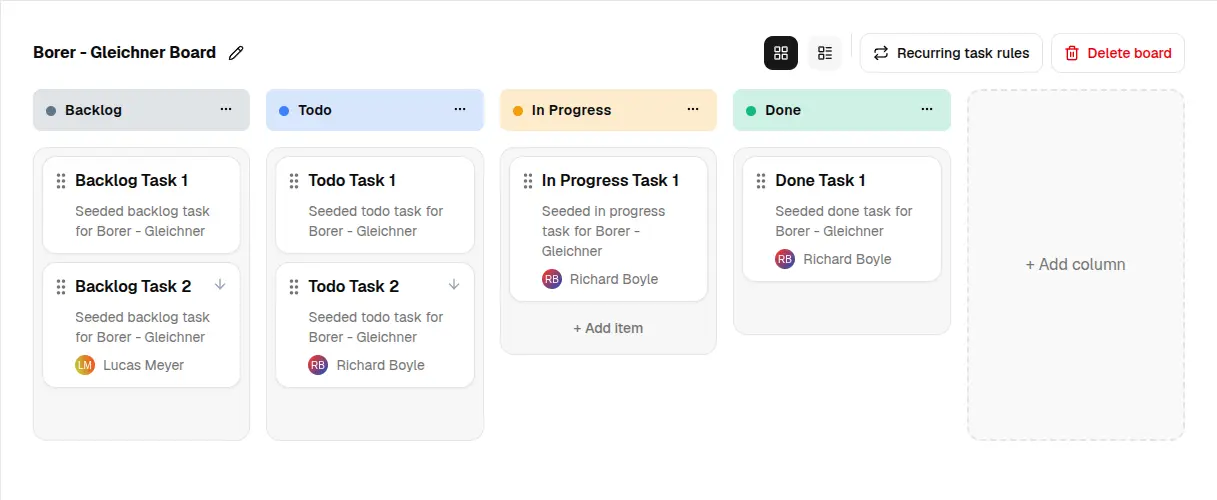
Seeded demo board, captured July 12, 2026. The columns and tasks illustrate the current board model.
Put the acceptance test in the task
A useful task title names the deliverable. The description can hold a concise completion test and the location of supporting evidence. Set a due date, assignee, and priority only when they communicate a real decision.
Example:
Title: Final accessibility audit for Acme checkout Complete when: report delivered, client contact confirms receipt, billable time reviewed, PO
AC-2048verified
Invoice Master task descriptions are limited and are not a file store or activity thread. Keep detailed work products and sensitive evidence in their proper systems.
Treat “Ready to bill” as a queue
Review that column on a fixed cadence—daily for active service teams, weekly for lower volume. For every card:
- confirm the correct customer and legal entity;
- review the quote or accepted scope;
- select project-linked time entries if the project and time-billing workflow applies;
- collect pass-through costs and purchase-order data;
- create or review the invoice draft; and
- record who completed the handoff.
After the invoice is saved, move the card according to your own policy. There is no automatic task-to-invoice link, so include the invoice number in the task description if that traceability matters.
Use priorities sparingly
Priority values from 0 to 5 can distinguish ordinary work from urgent contractual deadlines. Define the scale. If everything becomes 5, the field stops helping.
A practical rule is to reserve the highest level for work whose delay creates a customer, legal, safety, or material cash consequence. Due dates handle chronology; priority communicates consequence.
Recurring tasks are for recurring checks
Recurring task rules can create repeated operational reminders: review unbilled time every Friday, reconcile inventory movements monthly, or check the collections queue each morning. A recurring task does not create a recurring invoice, and a recurring invoice schedule does not create a task.
Connect them through process: the task reminds a person to inspect the system and complete the next action.
Apply work-in-progress limits as a team rule
Kanban often uses work-in-progress limits, but Invoice Master does not enforce a numeric limit on each column. You can still agree that no one starts a fourth task while three are in Doing, then review the board for violations. Treat that as a team policy, not a software feature.
Know the plan and feature boundaries
Basic supports up to ten tasks. Premium removes that task entitlement. There is no implemented board-count limit in the plan matrix. Current tasks do not include attachments, comments, per-task time logs, invoice conversion, or an activity feed.
Those boundaries keep the board’s role clear. It is a lightweight visual work system. The billing result still comes from the quote, time-billing, invoice, delivery, and payment workflows.